AI in HealthCare - How AI Startups Like JoyCalls and JoyLiving are Changing the Game
2 months ago 237

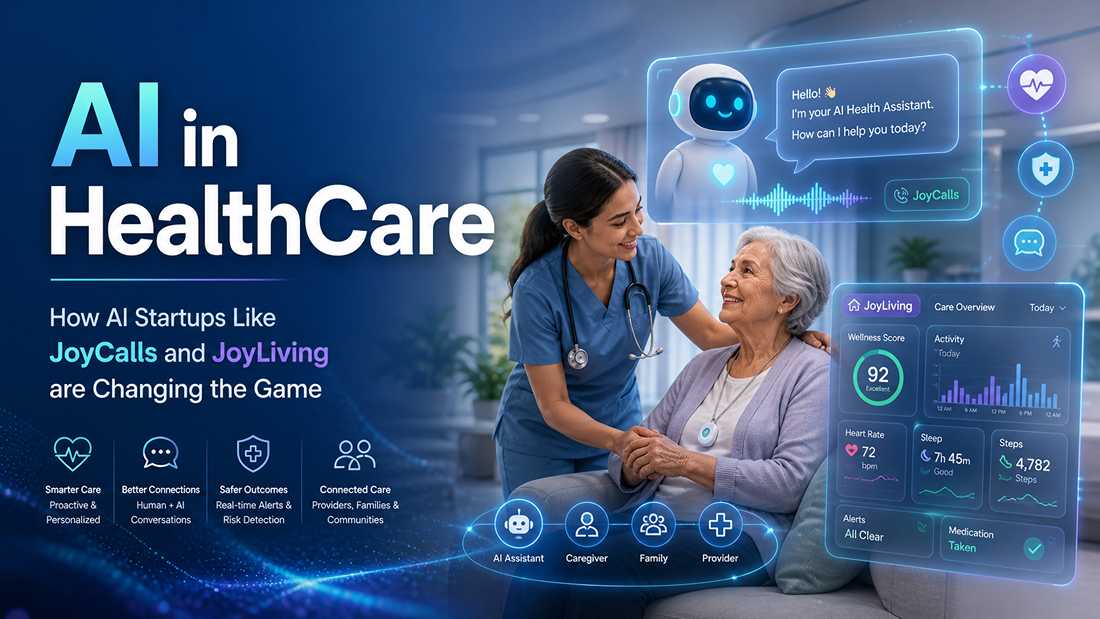
Healthcare has a strange problem.
It has never had more technology, more data, more devices, more apps, or more digital records.
And yet, for millions of patients, families, caregivers, and healthcare workers, the experience still feels painfully human in the worst ways.
Calls go unanswered.
Families do not know if an elderly parent is okay.
Senior living staff are buried under repetitive tasks.
Lonely older adults go days without meaningful conversation.
Small changes in mood, routine, memory, or behavior are missed until they become bigger problems.
Care teams are asked to do more with less.
This is where AI is starting to matter.
Not because AI will “replace doctors” or “replace caregivers.” That is the lazy version of the story.
The real change is more practical:
That is where startups like JoyCalls and JoyLiving are interesting. They are not trying to turn healthcare into science fiction. They are solving a very real, very expensive, very emotional problem: how to keep people connected, monitored, supported, and engaged when human caregivers cannot be everywhere at once.
When people think of AI in healthcare, they usually imagine hospital robots, diagnostic algorithms, radiology tools, or drug discovery platforms.
Those are important.
But a huge part of healthcare happens outside the hospital.
It happens when an older adult forgets medication.
It happens when a resident in a senior living community feels ignored.
It happens when a daughter living in another city worries about her father but cannot call him three times a day.
It happens when a care team is short-staffed and every phone call, reminder, check-in, and update becomes one more task.
It happens when loneliness slowly turns into decline.
The World Health Organization says the number of people aged 60 and older will rise from 1 billion in 2020 to 1.4 billion by 2030, and then to 2.1 billion by 2050. The number of people aged 80 and older is expected to triple between 2020 and 2050.
That means healthcare systems will not only need more doctors.
They will need more scalable care infrastructure.
They will need better ways to check in, listen, remind, alert, summarize, and coordinate.
That is the game AI startups are entering.
JoyCalls is built around a simple but powerful idea:
What if an older adult could receive regular AI-powered phone calls for companionship, reminders, games, and check-ins — without needing an app, login, tablet, or complicated setup?
That matters because many senior-tech products fail for a basic reason: they expect older adults to behave like smartphone-native users.
JoyCalls avoids that problem by using the phone.
Its website describes the product as a caregiving support tool that makes phone calls to loved ones, offering conversations, games, reminders, daily summaries, and alerts so families know the person is okay.
This is strategically smart.
The phone is familiar.
The phone does not require installation.
The phone does not require learning a new interface.
The phone is already part of the daily life of many older adults.
That makes JoyCalls less like a “tech product” and more like a lightweight care layer.
JoyCalls is not trying to be a hospital.
It is not replacing emergency care.
It is not diagnosing disease.
Its value is in the space between full-time caregiving and no support at all.
That space is huge.
A family member may not need a nurse to visit every day. But they may still want to know:
Did Dad sound okay today?
Did Mom remember her appointment?
Did she seem confused?
Did he mention pain, sadness, or loneliness?
Did she engage normally?
Did anything sound off?
JoyCalls can help create that daily rhythm.
The company describes its product as offering daily phone check-ins, conversations, games, reminders, summaries, and alerts.
That is not a small feature set. It is a practical answer to one of the most common family caregiving problems: “I want to check in more often, but I cannot always be available.”
Some people may say, “Isn’t this just an AI companion?”
Not really.
Companionship is part of healthcare when loneliness, isolation, routine breakdown, and missed reminders affect well-being.
The National Academies describes social isolation and loneliness in older adults as serious but underappreciated public health risks. It notes that about one-quarter of community-dwelling Americans aged 65 and older are socially isolated.
Research summarized in medical literature also links loneliness and social isolation in older adults with increased risks around dementia, coronary heart disease, stroke, mortality, depression, anxiety, and cognitive disorders.
So when an AI system helps an older adult stay connected, mentally engaged, reminded, and noticed, that is not merely “nice.”
It can become part of preventive care.
The key is not to overclaim.
JoyCalls should not be positioned as a medical cure.
It should be positioned as a practical support layer that helps families notice patterns earlier and reduce the invisible gaps in elder care.
That is where its power lies.
JoyCalls is mainly family-facing.
JoyLiving is more enterprise-facing.
JoyLiving is built for senior living communities, where the operational problem is bigger.
A senior living community may have dozens, hundreds, or even thousands of residents across locations. Staff need to handle resident requests, family calls, check-ins, reminders, satisfaction issues, service requests, and internal follow-ups.
That creates a brutal workflow problem.
If every small request becomes a phone call, every concern becomes a manual note, every family update becomes a separate task, and every resident check-in depends only on available staff, the system gets overloaded.
JoyLiving’s website describes it as an AI voice platform built for senior living communities, designed to improve staff efficiency, increase resident satisfaction, and improve operations.
Another JoyLiving page describes it as a voice AI platform that understands resident needs, automates requests from front desk to in-room care, and helps free staff from repetitive phone tasks.
That is a very different AI healthcare use case.
This is not just “AI talks to seniors.”
This is AI as an operational layer for senior care businesses.
Senior living communities are under pressure from all sides.
Residents expect better service.
Families expect faster communication.
Staff are stretched.
Operators need better visibility.
Small issues can become major complaints if ignored.
And unlike many software businesses, senior living cannot simply “automate everything.” Care is physical, emotional, and human.
So the right AI model is not replacement.
It is routing, summarizing, checking in, escalating, and reducing avoidable work.
JoyLiving’s enterprise launch materials describe a system combining resident check-ins, inbound call handling, and analytics to help communities reduce staff burden and improve quality of care.
That is the correct direction.
The future of AI in care is not one giant robot nurse.
It is thousands of small workflow improvements:
That is where AI becomes valuable.
Traditional care is often reactive.
Something happens.
Someone notices.
A call is made.
A staff member responds.
A note is written.
The issue is escalated.
That model works when problems are obvious.
It fails when problems are slow, subtle, emotional, or behavioral.
For example:
An older adult becomes quieter.
A resident stops joining activities.
Someone repeatedly mentions poor sleep.
A family member keeps calling because they feel uninformed.
A resident asks the same question more often than usual.
A person who used to enjoy conversations now gives short answers.
These may not be emergencies.
But they are signals.
AI systems like JoyCalls and JoyLiving can help collect these signals more consistently.
That is the important shift:
This is extremely valuable because many care problems do not begin as dramatic events. They begin as small changes.
A good AI system can help notice those changes earlier.
Not to replace clinical judgment.
But to help humans act sooner.
Text-based AI is useful.
But in elder care, voice is often more powerful.
Voice feels natural.
Voice carries emotion.
Voice does not require typing.
Voice can work through ordinary phones.
Voice can reveal hesitation, confusion, energy, mood, and engagement in ways that forms and apps cannot.
That is why JoyCalls and JoyLiving are strategically well-positioned.
They are not forcing seniors into a cold dashboard.
They are meeting them through conversation.
This matters because the biggest barrier in senior technology is not always technical capability.
It is adoption.
The best product is not the one with the most features.
The best product is the one people actually use.
For older adults, especially those who are not comfortable with apps, phone-first and voice-first design can reduce friction dramatically.
JoyCalls’ positioning around “no apps, no setup” is therefore more important than it may look at first.
That phrase is not just marketing.
It is product strategy.
Family caregiving is emotionally heavy.
Many adult children are stuck between work, their own children, distance, money, and guilt.
They want to call more.
They want to visit more.
They want to know what is happening.
But life gets in the way.
This is where AI can be emotionally useful.
A system like JoyCalls does not replace the child, sibling, spouse, or caregiver.
It gives the family an extra layer of reassurance.
The family still matters.
The human calls still matter.
The visits still matter.
But now there is a daily support rhythm between those moments.
The most powerful family-care AI will not say:
“You no longer need to call your parent.”
It will say:
“You can stay more aware, more consistently, even when life is busy.”
That is a much better promise.
It is honest.
It is useful.
And it respects the emotional reality of caregiving.
Healthcare workers and senior living staff do not need another technology tool that makes their day harder.
They need relief.
This is why JoyLiving’s staff-efficiency angle matters.
A care team does not want to log into five systems to understand what happened with one resident.
A front desk team does not want to answer the same basic question twenty times a day.
A manager does not want to rely only on memory, scattered notes, and family complaints to understand resident satisfaction.
AI can help if it removes repetitive work.
AI becomes harmful if it adds another layer of admin.
The right product design principle is simple:
For senior living communities, that means AI should help with:
JoyLiving’s positioning around voice AI, request automation, and analytics points directly at this problem.
This is what makes it more than a “chatbot.”
A chatbot answers questions.
A healthcare AI operations layer helps the organization run better.
In healthcare and senior care, trust is the product.
Families choose a care provider because they trust it.
Residents stay because they feel safe, respected, and seen.
Staff perform better when systems support them.
Leadership wins when quality is visible and consistent.
AI helps when it improves trust.
JoyCalls can help families trust that someone is checking in consistently.
JoyLiving can help communities respond faster and operate with more visibility.
Both products attack the same root problem from different sides:
JoyCalls helps reduce care gaps inside families.
JoyLiving helps reduce care gaps inside senior living operations.
That is why these startups matter.
They are not just adding AI to healthcare because AI is fashionable.
They are targeting moments where human systems are already strained.
The opportunity is huge, but healthcare AI startups need discipline.
There are several mistakes they must avoid.
AI companionship, check-ins, reminders, and summaries are valuable.
But they should not be marketed as diagnosis or emergency care unless properly regulated, validated, and clinically governed.
This distinction matters.
A tool that helps identify concerning patterns is different from a tool that diagnoses a condition.
A tool that reminds someone about medication is different from a tool that changes medication.
A tool that alerts family or staff is different from a tool that makes a clinical decision.
The safest and smartest positioning is:
AI supports care. Humans remain responsible for care.
If every unusual phrase becomes an alert, staff will ignore the system.
The goal is not more alerts.
The goal is better alerts.
AI should help prioritize what matters.
Good design means fewer useless interruptions and more meaningful escalations.
There is a difference between support and surveillance.
The language, tone, consent process, and product experience matter.
Older adults should feel respected, not watched.
The best AI care products will feel warm, useful, and optional — not controlling.
AI should not become a wall between families and loved ones.
It should become a bridge.
The best products will encourage better human connection, not replace it.
Healthcare-adjacent conversations can contain sensitive personal information.
Products like JoyCalls and JoyLiving need strong privacy, security, consent, access control, and data governance.
In care, trust can be destroyed quickly if data is handled poorly.
The first wave of AI excitement was about intelligence.
Can AI answer questions?
Can AI write?
Can AI summarize?
Can AI detect patterns?
The next wave is about integration.
Can AI fit into real human workflows?
Can it help a family?
Can it help a senior living operator?
Can it work through a phone?
Can it reduce staff burden?
Can it improve satisfaction?
Can it create useful alerts?
Can it support care without pretending to replace care?
JoyCalls and JoyLiving are interesting because they are not abstract AI tools.
They are built around specific healthcare-adjacent use cases.
JoyCalls focuses on seniors and families.
JoyLiving focuses on senior living communities.
Both are operating in an area where the need is obvious and growing.
The aging population is rising sharply. Loneliness and isolation are recognized public health concerns. Care staff are overloaded. Families are anxious. Senior living operators need better systems.
That is the kind of market where AI can move from “interesting demo” to “daily utility.”
The future of AI in healthcare will not be one product.
It will be a care coordination layer across many settings.
At home, AI can call, remind, check in, summarize, and alert.
In senior living, AI can route requests, reduce phone workload, support staff, and analyze resident satisfaction.
In clinics, AI can prepare summaries, follow up with patients, and identify who needs attention.
In hospitals, AI can support documentation, triage, scheduling, and discharge follow-up.
For chronic care, AI can help monitor behavior, adherence, lifestyle, and early warning signs.
For caregivers, AI can reduce the mental load.
This is the real game.
Healthcare does not only need better treatments.
It needs better continuity.
JoyCalls and JoyLiving are part of that continuity layer.
They help answer a question healthcare systems have struggled with for decades:
What happens between visits, between shifts, between calls, and between emergencies?
That is where many problems begin.
That is where AI can help.
AI in healthcare is often discussed in grand, futuristic language.
But the most useful AI may be quieter.
It may sound like a daily phone call.
It may look like a summary sent to a family member.
It may be an alert that tells staff a resident needs attention.
It may be an automated response that saves a care worker ten minutes.
It may be a pattern that shows leadership where residents are unhappy.
That is how AI changes healthcare in the real world.
Not by replacing the human heart of care.
But by making sure care happens more often, more consistently, and with better information.
JoyCalls and JoyLiving show where the industry is heading.
JoyCalls helps families support older adults through simple AI-powered phone calls, reminders, conversations, summaries, and alerts.
JoyLiving helps senior living communities use voice AI to improve staff efficiency, resident satisfaction, inbound call handling, check-ins, and operational visibility.
Together, they point to a bigger shift:
Healthcare AI is moving from hospitals to homes, from diagnosis to daily support, and from reactive care to continuous care.
That is why startups like JoyCalls and JoyLiving are changing the game.
Comments (0)