What Makes a Medication App Easy to Stay With
6 months ago 292

Author: Shir Keren
Shir Keren works at AppMakers USA as a Project Manager and QA Analyst, keeping teams aligned and releases dependable. She supports planning, day to day coordination, and hands-on testing, with a strong focus on usability and detail. Outside the studio, she is usually hiking with her dog, cooking something new, or working on creative side projects.
One of the hardest problems in healthcare is also one of the most ordinary.
A patient gets the right prescription, the right advice, even the right follow-up plan, and still does not stick with it.
Sometimes that happens because of cost. Sometimes because of side effects. Sometimes because life gets busy, the schedule gets messy, and the plan quietly starts to fall apart.
That is where health apps can help. Not by nagging people harder, but by making the next right step easier.
This matters because medication adherence is still a major problem worldwide. The World Health Organization has long estimated that adherence among patients with chronic conditions averages only around 50% in developed countries, and often less in developing countries. That is not a small gap. That is half the system leaking.
The question is not whether health apps should try to support adherence. They should. The better question is how they can do it without becoming another thing patients want to mute, ignore, or delete.
The apps that help most usually do a few simple things well.
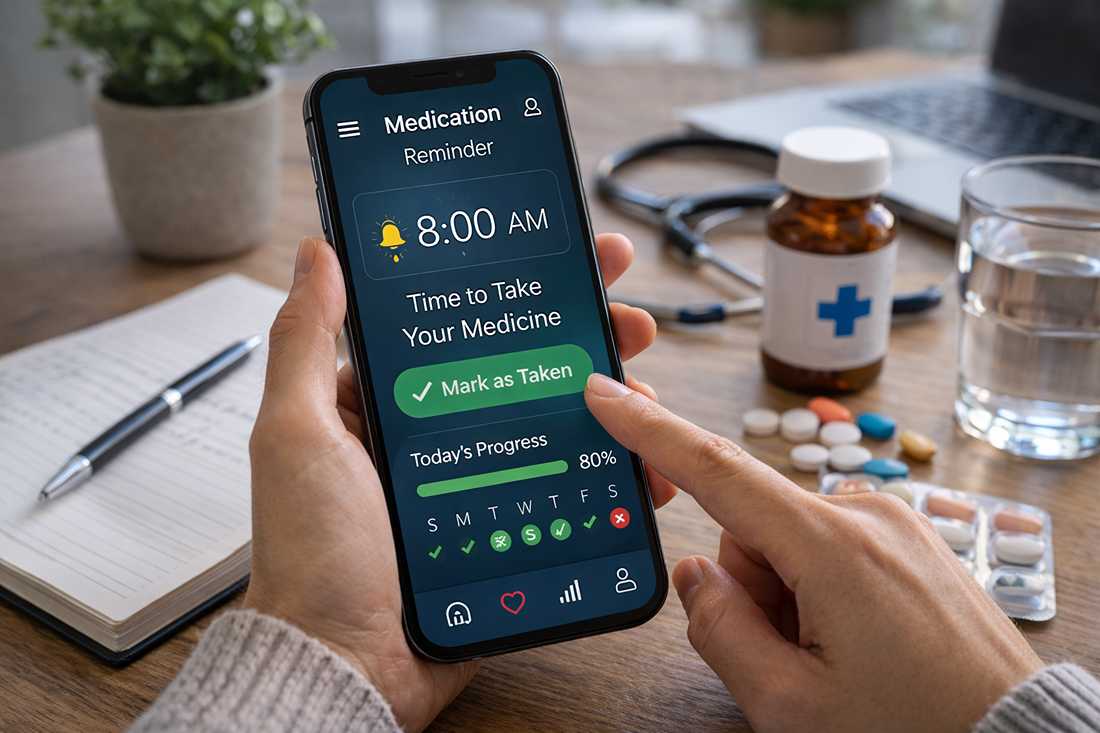
A reminder is the most obvious adherence feature, and also the easiest one to get wrong.
A lot of apps assume the answer is frequency. More alerts. More nudges. More “Don’t forget.”
That usually backfires.
A better reminder system does three things:
For example, “Take your evening blood pressure medicine now” is stronger than “Medication reminder.”
And timing matters more than teams expect. If a patient takes medicine after dinner, a 2 p.m. notification is not helpful just because it is technically “the same day.”
The best reminder tools usually let the patient shape the schedule around real life. Morning shift, night shift, mealtimes, school runs, prayer times, commuting. That is what makes the reminder feel supportive instead of robotic.
One more thing that matters: quiet escalation. If a dose is missed, not every app needs to act like an alarm system. Sometimes a gentle follow-up is enough. Sometimes a second reminder later in the day works better than a harsh warning immediately.
People miss doses. That part is real.
What matters next is what the app does.
A lot of reminder apps treat a missed dose like a failure. The language gets stiff. The screen gets red. The user feels judged.
That is bad product thinking for healthcare.
A better approach is simple:
Something as small as “Missed this one? Log what happened and we’ll help you stay on track” works better than a screen that just says “Dose missed.”
This matters because adherence is not only about memory. It is also about emotion. Patients who already feel overwhelmed do not need an app that makes them feel worse.
In real life, many adherence problems come from routine disruption. Travel. Illness. Work shifts. Family emergencies. A useful app does not pretend those things do not exist. It helps the patient recover without friction.
Some health apps borrow heavily from fitness and language apps. Streaks. Badges. Daily wins.
A little of that can help. Too much can feel tone-deaf fast.
Healthcare is different.
If someone is managing blood pressure, diabetes, asthma, or post-surgical recovery, they do not always want a confetti animation because they logged a dose. Sometimes they just want to feel organized and reassured.
That is why good adherence tracking tends to be quieter:
The goal is not to turn treatment into a game. It is to help patients see patterns.
This is especially useful in chronic care. A patient who sees that missed doses often happen on weekends, or after night shifts, has something concrete to discuss with a clinician. That is much more helpful than a generic “you are at 72% adherence” number with no context.
Some patients manage treatment on their own. Some do not.
Older adults, teenagers, post-operative patients, and people with memory difficulties may rely on a spouse, parent, sibling, or caregiver to stay on track.
This is where many health apps are still underbuilt.
A smart adherence app often needs optional shared visibility, such as:
The important word is optional.
The feature should help support patients who want shared accountability, without making everyone feel watched.
That balance matters a lot in healthcare. Too little support and the app becomes useless for vulnerable users. Too much surveillance and people stop trusting it.
Adherence does not fail only when someone forgets a dose. It also fails when the medicine is simply not there.
Running out of medication is one of the most basic breakdowns in the system, and apps can help more here than people think.
Good refill support can include:
This is where product execution matters. A reminder that says “Refill soon” but gives the patient no next step is not useful. A reminder that leads straight into a refill request or pharmacy contact path is.
The reason this matters clinically is obvious. A patient may fully intend to stay adherent and still fall behind because the refill process is slow, confusing, or easy to postpone.
That kind of friction is exactly where health apps should help.
This is the part a lot of product teams miss.
Notification fatigue is real.
If an app sends too many messages, even good ones, patients start tuning all of them out. Then the one alert that actually matters gets ignored with the rest.
A better rule is to send fewer, smarter prompts.
For example:
That kind of restraint usually takes stronger product discipline. It is easier to send more messages and call it engagement.
But in healthcare, more messages do not always mean more support.
This is where a strong mobile app development company can add real value in patient-facing products. The goal is not just to build an app that sends reminders. It is to build one that understands when reminders help, when they become noise, and where the bigger issue is friction somewhere else in the patient journey.
The biggest adherence wins are not always dramatic.
Sometimes they are tiny features that remove one repeated headache:
The CDC has also emphasized that better adherence is tied to better outcomes and lower avoidable healthcare use. That is why these “small” product choices matter. They are not cosmetic.
In healthcare apps, convenience is not fluff. Convenience can be adherence.
The health apps that actually improve adherence usually understand one thing clearly.
Patients are not failing because they need more pressure. Most of the time, they need less friction, better timing, and clearer support.
That means the best features are rarely the noisiest ones.
They are the ones that quietly help people do what they already want to do:
That is the difference between a health app that gets installed and a health app that genuinely becomes part of care.
And in a space where so many patients still struggle to stay adherent, that difference matters a lot.
Comments (0)