How Musick AI is Finally Giving Your Imagination a Voice
7 months ago 514

You know that feeling. It hits you while you are driving, or perhaps in that space between waking and sleeping. A melody. A rhythm. A fully formed chorus that sounds absolutely perfect in the concert hall of your mind. You can hear the swell of the violins or the grit of the bass guitar. It is visceral. It is real.
But then, the moment passes. You try to hum it into your voice memos, but it just sounds like... humming. The grandeur is lost in translation. For decades, this has been the tragic gap for millions of creative souls. Unless you spent years mastering complex Digital Audio Workstations (DAWs), learned music theory, or had the budget to hire a studio, your musical ideas were destined to evaporate.
This silence is not just frustrating; it is a loss of human potential. How many masterpieces have never been heard because the barrier to entry was simply too high? We live in a world where we can capture 4K video with a phone, yet creating high-quality music has remained guarded behind the gates of technical skill and expensive hardware.
I recently found myself staring at this exact problem. I needed a specific background track for a project—a blend of "melancholic jazz" and "futuristic synth-wave." A strange combination, I know. Searching stock audio libraries was a nightmare of generic loops and soulless jingles.
That is when I opened Musick AI.
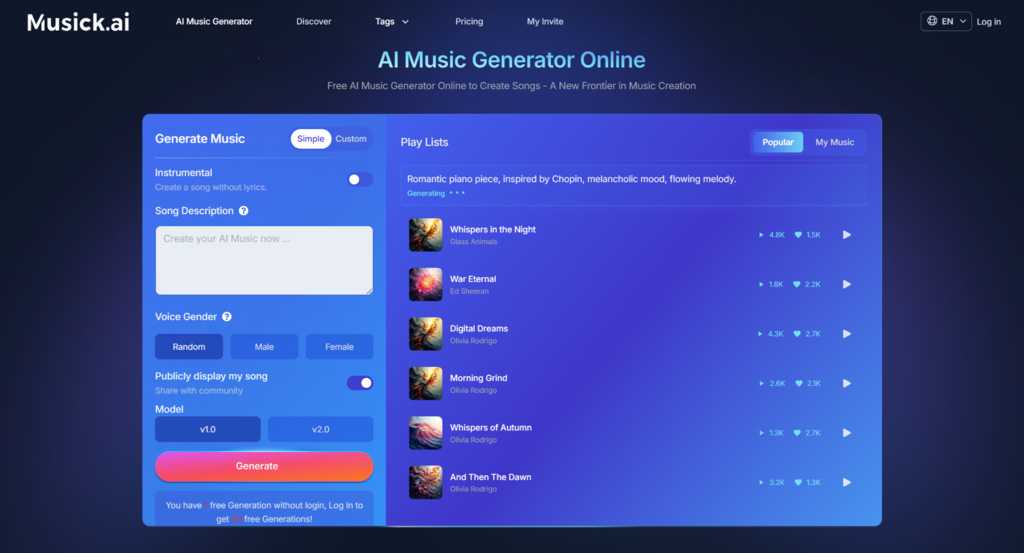
I admit, I was skeptical. As a storyteller, I value authenticity. Can an algorithm truly capture emotion? I decided to treat the interface not like a machine, but like a collaborator. I typed in my prompt, describing the mood, the instruments I heard in my head, and the tempo.
I hit generate.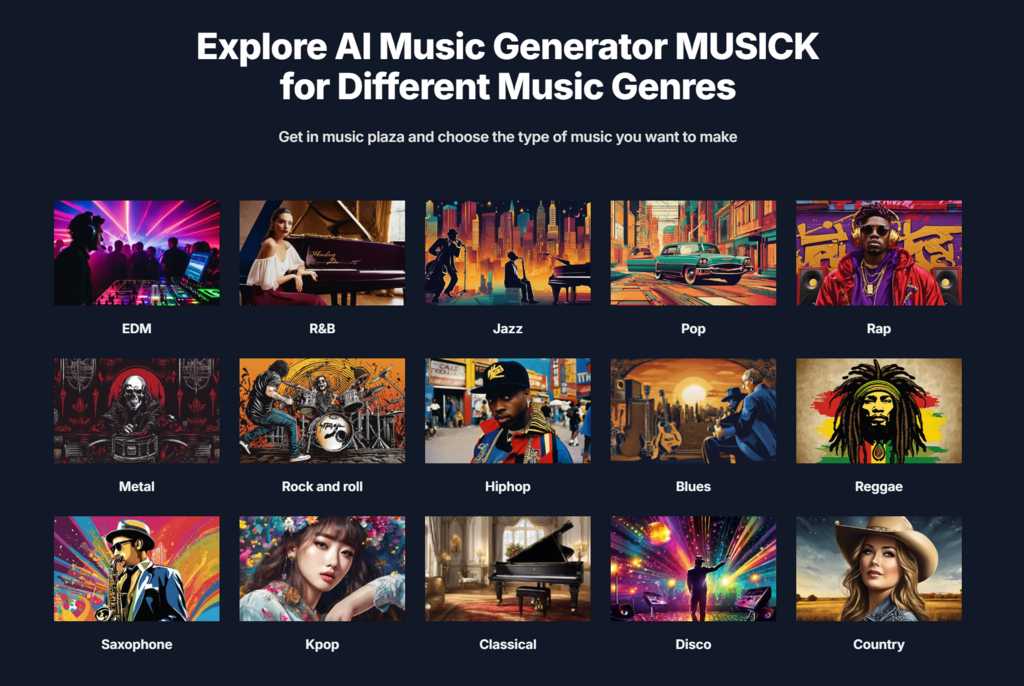
What happened next felt less like computing and more like alchemy. Within moments, the platform didn't just spit out noise; it composed a song. It caught the smoky vibe of the jazz saxophone I wanted and layered it perfectly over a cold, driving synth beat. It wasn't just "correct"; it was musical.
This wasn't a random assembly of sounds. It felt like the AI understood the narrative I was trying to tell. This is the core of what makes this platform distinct. It functions less like a tool and more like a session musician who instantly gets your vibe.
To understand why this shifts the paradigm, we have to look at the mechanics through a different lens. Think of traditional music production like painting with oil paints. It is messy, requires years of practice to mix colors, and if you make a mistake, it is hard to fix.
Using this platform is like photography. You frame the shot (your prompt), you adjust the lighting (your settings), and the engine captures the image.
The process is deceptively simple, masking a complex neural architecture beneath.
One feature that genuinely surprised me was the Music Plaza. Creativity can be lonely, but here, it is communal. Browsing through the Plaza feels like walking through a digital record store where every album was released *today*. You can hear what others are creating, from K-Pop ballads to heavy metal instrumentals.
It serves a dual purpose: it is a source of entertainment, but more importantly, it is a learning tool. You can see the prompts others used to get their results, allowing you to reverse-engineer success and refine your own "prompt engineering" skills for music.
If you are a content creator, a marketer, or a storyteller, you understand that music is not just background noise; it is emotional shorthand. It tells the audience how to feel before you even speak a word.
This shift from "searching" to "creating" is massive. It saves time, yes, but it also ensures your content has a unique sonic fingerprint that no one else is using.
To truly appreciate the value proposition, we need to look at where this solution sits in the market landscape. It is not trying to replace Hans Zimmer; it is trying to empower *you*.
| Feature / Aspect | Traditional Studio Production | Generic Stock Audio Sites | Musick.ai Experience |
| Cost | High ($$$$) - Studio time & engineers | Moderate ($$) - Subscription fees | Free / Accessible |
| Time to Result | Weeks or Days | Hours of searching | Seconds |
| Customization | High, but requires expertise | None (What you hear is what you get) | High (Text-driven control) |
| Uniqueness | Unique | Non-Exclusive (Others use same tracks) | Unique Generation every time |
| Skill Requirement | Professional Training | Basic Editing | Imagination only |
| Ownership | Complex Rights Management | Limited Licensing | Creator-Focused |
There is a valid fear that AI removes the human touch. However, my experience suggests the opposite. By removing the technical friction—the struggle with equalizers, compression, and mixing—the tool allows you to focus purely on the *feeling*.
It is similar to how word processors didn't kill writing; they just made it easier to edit and publish. This platform is a word processor for melody. It invites you to play.
We are entering an era of "musical literacy" that has nothing to do with reading sheet music. It is about understanding mood, genre, and emotional arc. When you use the platform, you start learning the vocabulary of sound. You learn that "reverb" creates space, or that "lo-fi" creates intimacy. You become a director of sound, even if you cannot play a single chord on a piano.
We are living in the golden age of the creator economy. The demand for content is insatiable. But the tools for video and text have historically outpaced the tools for audio. We have had Instagram for images and ChatGPT for text, but audio remained stuck in the difficult-to-master category.
This platform represents the democratization of the final frontier of content creation. It levels the playing field. A teenager in their bedroom now has access to the same sonic quality as a boutique marketing agency.
The silence in your head doesn't have to stay there. That melody you dreamt of? It deserves to be heard. Whether you need a backing track for a podcast, a unique beat for a rap, or just want to experiment with sound, the barrier is gone.
The only limit left is your own creativity. The orchestra is warming up, and for the first time in history, the AI Music Generator is in your hand, waiting for you to lift it.
Comments (0)