Sora 2’s Physics Meets Veo 3’s Cinematography: Access the Perfect Duo on SotaVideo
9 months ago 573

For the independent creator, the gap between "vision" and "reality" has always been defined by one thing: Compromise.
You have the script for a sci-fi epic, but you don't have the VFX team to simulate zero-gravity physics. You have the perfect mood for a travel documentary, but you can't afford the cinema lenses to get that creamy depth of field. For years, we have relied on overused stock footage or scaled down our ideas to fit our resources. We are the writers, directors, and editors, but we are often limited by the physical constraints of production.
That era of compromise is ending.
The arrival of generative video isn't just a tech novelty; it is the democratization of the "establishing shot." It is the ability to conjure a drone shot of a cyberpunk city or a macro shot of a blooming flower without leaving your desk. However, no single AI model is perfect at everything. Some excel at motion, others at lighting.
This is where SotaVideo changes the game. By aggregating the industry's two most powerful models—Sora 2 and Veo 3—into a single platform, SotaVideo offers the "Perfect Duo." It combines the physics-defying realism of OpenAI with the cinematic grandeur of Google.
If you are a video enthusiast looking to expand your creative palette, here is why SotaVideo is the best platform to integrate this powerful duo into your workflow today.
Every editor knows the pain of "stock footage hell." You search for "sad man in rain," and you get hundreds of clips that look fake, have the wrong lighting, or feature models looking directly into the camera awkwardly. You spend hours searching, and you settle for something "good enough."
SotaVideo changes the dynamic from searching to generating.
Instead of hunting for a shot that might fit, you describe exactly what you need. Do you need a "cinematic, low-angle shot of a detective walking down a rainy London street in 1920, moody lighting, film grain"? Type it into SotaVideo.
By giving you access to Sora 2, the platform allows you to generate specific, narrative-driven B-roll. Sora 2 is particularly adept at handling complex physics and object interactions. If your scene requires a car kicking up dust on a dirt road, Sora 2 understands the physics of dust particles and tire friction. This isn't just a pretty picture; it's a simulation. This capability makes SotaVideo the best platform for filling the gaps in your timeline with footage that looks and feels bespoke, not generic.
While Sora 2 is the master of physics and realism, Google’s Veo 3—also available on SotaVideo—is the master of the lens.
For creators who obsess over composition, depth of field, and color grading, Veo 3 is a revelation. It seems to have "studied" the history of cinema. When you ask for "golden hour lighting" or "anamorphic lens flares," Veo 3 delivers results that mimic high-end cinema cameras like ARRI or RED.
SotaVideo creates a unique advantage by housing both models under one roof.
Having both tools in a single interface turns SotaVideo into a complete production studio. You are no longer limited by the aesthetic of a single AI model; you can mix and match to find the perfect visual tone for your project.
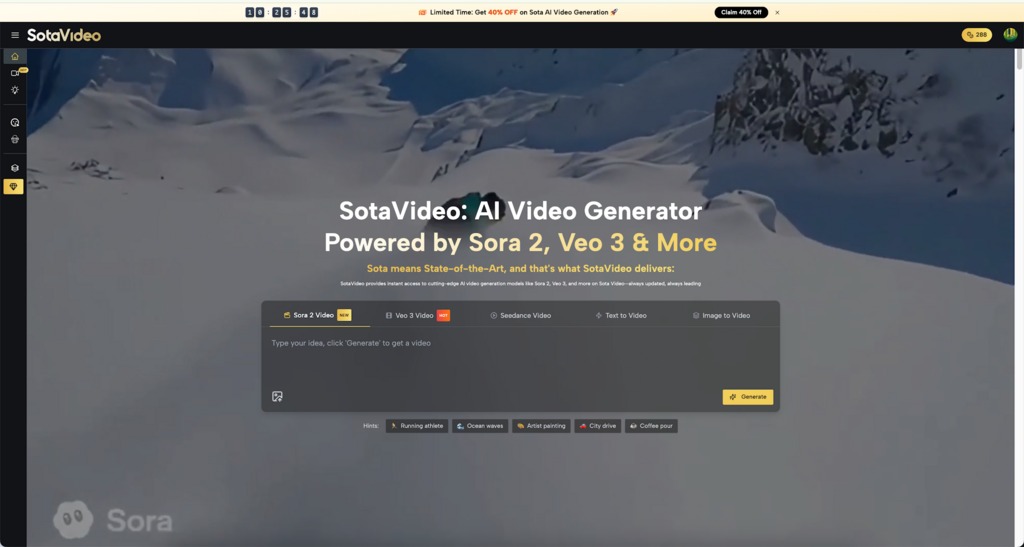
You don't need a manual to use SotaVideo. If you can send a text, you can make a movie. Here is how to generate your first clip in seconds:
Step 1: Choose Your "Engine" Look at the tabs above the text box.
Step 2: Type Your Vision Click on the main text box where it says "Type your idea...". Describe the scene you see in your head. Be specific about the lighting, the action, and the mood.
Step 3: Click Generate Hit the yellow [Generate] button on the right. In just a moment, SotaVideo will turn your text into a fully rendered video clip, ready for you to download and drag into your timeline.
SotaVideo isn't just for generating final clips; it is a powerful pre-production tool that leverages the strengths of both models.
Sketching stick figures on a napkin is fine, but imagine showing your cast and crew a fully rendered video of the scene before you shoot it. Directors are using SotaVideo to generate "rip-o-matics" or animatics. You can test camera movements, lighting setups, and color palettes instantly. It saves time on set because everyone knows exactly what the "vibe" should be.
Let’s say you are reviewing a tech product, but you want to talk about the history of the internet. You can't film the internet. But with SotaVideo, you can generate abstract visualizations of data streams, futuristic server rooms, or digital neural networks to play in the background while you talk. It elevates the production value of "talking head" videos instantly.
For indie musicians or editors making fan edits, SotaVideo is a playground. You can generate clips that react to the mood of the song. Deep bass? Generate slow-motion explosions or crashing waves using Sora 2's physics engine. Fast hi-hats? Generate glitchy, fast-moving city lights with Veo 3's high fidelity. The synchronization of AI visuals with audio is a new frontier for creative expression.
As a creator, you care about efficiency. You want to spend your time editing and colour grading, not fighting with clunky software. SotaVideo is built with the creator's workflow in mind.
The "Prompt-to-Timeline" Frictionless Experience: Many AI tools are hosted on Discord servers, which are messy, public, and hard to organise. SotaVideo offers a clean, web-based dashboard. You can organise your generations, download them easily, and drag them straight into Premiere Pro, DaVinci Resolve, or Final Cut.
Understanding Technical Prompts: SotaVideo is optimised to understand camera terminology. You can use terms like "wide shot," "macro," "dolly zoom," "4k," "highly detailed," and "OLED contrast." The platform parses these technical requests effectively, passing them to Sora 2 and Veo 3 in a way that ensures the output matches your cinematic vision.
Cost-Per-Project Flexibility: Indie creators often work in bursts. You might have a busy month editing a short film, followed by a month of writing where you don't need video generation. Monthly subscriptions to individual enterprise models can burn a hole in your pocket. SotaVideo’s credit-based or flexible access models mean you pay for the render power you use. It’s like renting a camera only for the days you shoot, rather than buying it outright.
There is a fear among some creatives that AI will replace the artist. But if you spend ten minutes on SotaVideo, you realize that isn't true. The AI creates the pixels, but you create the vision.
A camera doesn't take a great photo; a photographer does. Similarly, Sora 2 and Veo 3 don't make a great movie; you do. SotaVideo simply removes the barrier of entry. It hands you the keys to a multimillion-dollar studio and asks, "What do you want to make?"
So, stop searching for the perfect stock clip. Stop compromising on your vision because of the budget. Go to SotaVideo, access the perfect duo, and drag your dreams onto your timeline. The only limit left is your imagination.
Comments (0)