Unlocking Your Inner Composer: A Deep Dive into the Future of Sound with ToMusic
8 months ago 400


Imagine standing at the edge of a creative cliff. You have the perfect video, the most compelling script, or a game concept that could change the industry. The visuals are stunning, the narrative is tight, but something is missing. It’s the soul of the project—the music.
For years, you had two painful choices: spend hours scouring stock audio libraries for a generic track that thousands of others are already using, or burn your budget hiring a professional composer. The silence in your workflow isn't just a lack of sound; it is a barrier to your expression. It is the frustration of hearing a melody in your head but having no way to pull it out into the real world.
But what if the barrier wasn't there? What if you could simply describe the feeling, the rhythm, or the story, and have a virtual studio orchestra bring it to life in seconds? This is where the landscape shifts. This is where we introduce a game-changer。
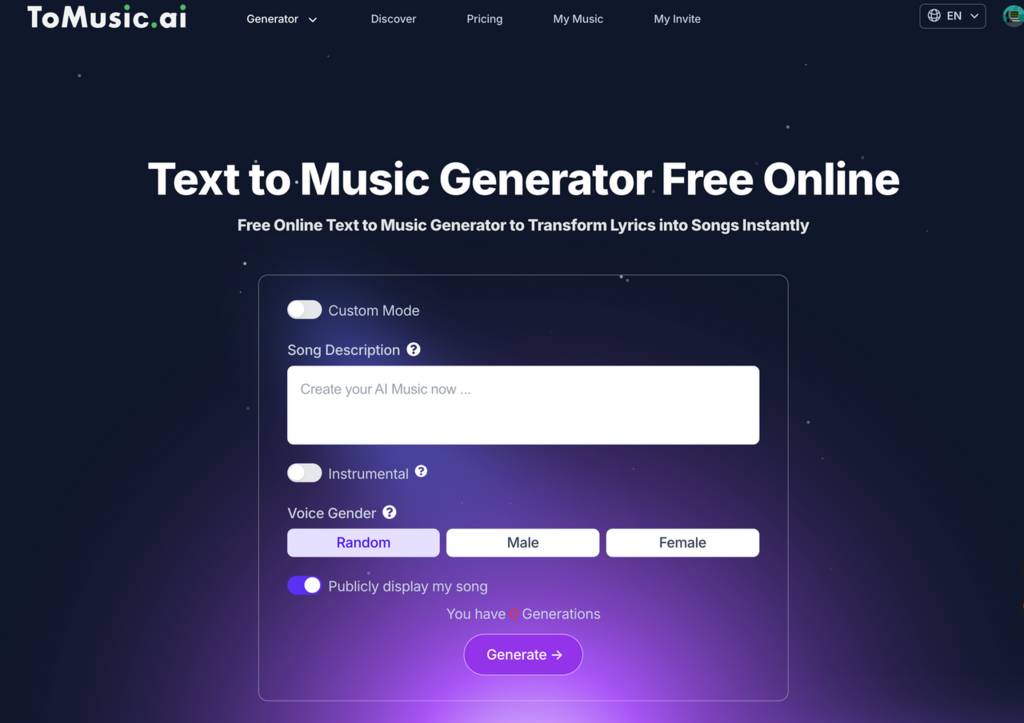
We are witnessing a renaissance in digital creativity. Just as AI transformed writing and visual art, it is now reshaping the auditory world. Enter ToMusic AI. It is not just a tool; it is a bridge between your raw ideas and professional-grade audio.
During my time exploring various creative tools, I have often felt that technology can sometimes get in the way of art. Interfaces get cluttered, and the learning curve becomes a wall. However, my recent deep dive into this platform revealed something different. It feels less like a piece of software and more like a collaborative partner—an AI music agent that listens to your intent rather than just processing your inputs.
The premise is deceptively simple, yet the technology behind it is profound. You are not dragging and dropping pre-made loops. You are not tweaking equalizers unless you want to. Instead, you are acting as the director.
You provide the context—a mood, a genre, a specific instrument, or even a lyrical theme. The AI Music Maker engine then analyzes the semantic weight of your words. It understands that "melancholic rain in a cyberpunk city" requires a different sonic texture than "upbeat summer road trip." It synthesizes these concepts into a unique audio file that has never existed before.
I decided to put the platform to the test with a specific challenge. I needed a background track for a tech review video—something that sounded futuristic but not distracting, with a driving rhythm but a soft edge.
What struck me most was the emotional resonance. Usually, AI-generated content can feel cold or robotic. But this track had "swing"—that subtle human imperfection in the rhythm that makes music feel alive. It was a moment of genuine surprise. I wasn't just a user; I was a creator, unburdened by my lack of musical training.
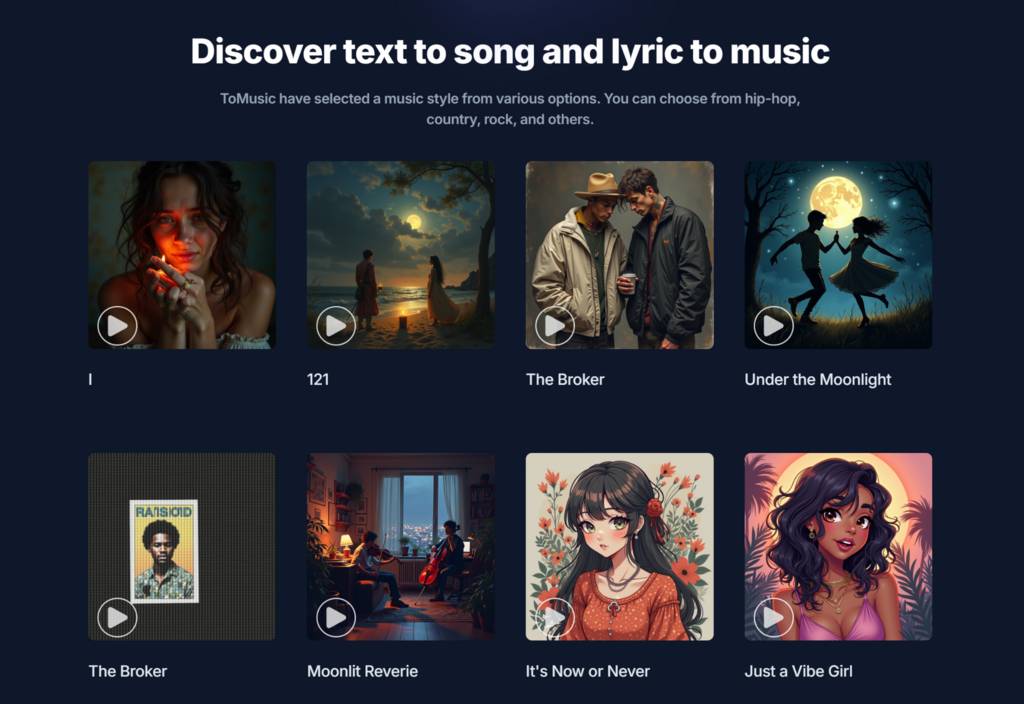
The democratization of music production means that the AI music maker is no longer a novelty toy; it is a vital asset for content strategy. Whether you are a YouTuber, a podcaster, or a marketing director, the ability to generate bespoke audio on demand solves three critical problems: copyright strikes, budget constraints, and creative stagnation.
Let's look at what makes this specific platform stand out in a crowded market.
To truly understand the value proposition, we need to look at the alternatives. How does this AI song maker stack up against traditional stock music platforms or hiring a human composer?
The following table breaks down the key differences that I observed during my testing.
| Feature / Aspect | Traditional Stock Music | Human Composer | ToMusic (AI Agent) |
| Originality | Low (Non-exclusive, reused) | High (Bespoke) | High (Unique generation) |
| Cost Efficiency | Moderate (Subscription/Per track) | Low (Expensive) | High (Affordable/Scalable) |
| Speed of Delivery | Fast (Search & Download) | Slow (Weeks/Months) | Instant (Seconds) |
| Customization | None (What you hear is what you get) | High (Iterative feedback) | High (Prompt refinement) |
| Copyright Safety | Variable (Complex licensing) | High (Contract based) | High (Royalty-free focus) |
| Learning Curve | Low | N/A (You hire talent) | Low (Natural Language) |
Think of your content creation process before this tool. You likely spent hours scrolling through "Cinematic Epic Music" playlists, settling for a track that was almost right but slightly too loud or too short.
Now, visualize the process after adopting an **AI music agent**. You finish your video edit. You realize you need a 30-second intro that transitions from suspense to joy. You ask for exactly that. You get it. You download it. You are done. This isn't just saving time; it is preserving your creative momentum.
While anyone can play with it, I found specific groups will benefit the most from this technology.
For YouTubers and TikTok creators, the background music defines the vibe. Using unique AI-generated tracks helps establish a signature sound that isn't flagged by copyright bots.
Indie developers often wear many hats. Being able to generate ambient tracks or boss battle themes without hiring an external sound engineer allows resources to be allocated to gameplay and graphics.
Ad campaigns need to evoke emotion quickly. An AI music maker allows marketers to A/B test different musical moods for the same ad copy to see which one converts better—a strategy that was previously too expensive to execute.
We are moving away from a world of passive consumption into an era of active co-creation. Tools like this do not replace human creativity; they amplify it. They remove the technical friction that exists between a thought and its expression.
When I listened back to the track I created, I didn't hear an algorithm. I heard my own idea, translated into a language I couldn't speak fluently—the language of music.
If you are ready to stop searching for the perfect sound and start creating it, the solution is right at your fingertips. It is time to let your stories sing.
In the rapidly evolving world of generative technology, ToMusic stands out not just for its technical capability, but for its user-centric design. It understands that at the end of the day, you are telling a story. Whether that story is a 15-second reel or a 10-minute documentary, the soundtrack is the heartbeat.
Don't let the silence hold you back. Embrace the power of the AI music agent and turn your text into a masterpiece.
Comments (0)