Active Aging in BC: Physiotherapy for Senior Mobility balance
8 months ago 433


British Columbia is home to one of Canada’s most active senior populations. With mild coastal winters, abundant parks, and a culture that celebrates outdoor living, many retirees in the Lower Mainland continue hiking, golfing, gardening, and volunteering well into their 70s and 80s. In Langley alone, neighbourhoods like Willoughby, Walnut Grove, and Brookswood are filled with 55+ communities where pickleball courts stay busy year-round and walking groups meet daily along the Nicomekl River or Houston Trail.
Yet biology eventually catches up. By age 65, muscle mass has typically declined 20–30 % from peak levels, reaction times slow, and balance becomes less reliable. Falls are the number-one cause of injury among Canadian seniors, responsible for over 90 % of hip fractures and thousands of hospital admissions in BC each year. One in three adults over 65 will fall at least once annually, and in the Fraser Valley that statistic holds steady or higher because so many seniors remain physically active on uneven terrain or icy surfaces.
Physiotherapy has become a cornerstone of successful aging in the province. Community-based programs in Langley, Surrey, and Abbotsford help seniors maintain strength, coordination, and confidence — allowing them to keep enjoying everything from the Fort Langley cranberry festival to grandkids’ soccer games at Willoughby Community Park without fear of injury.
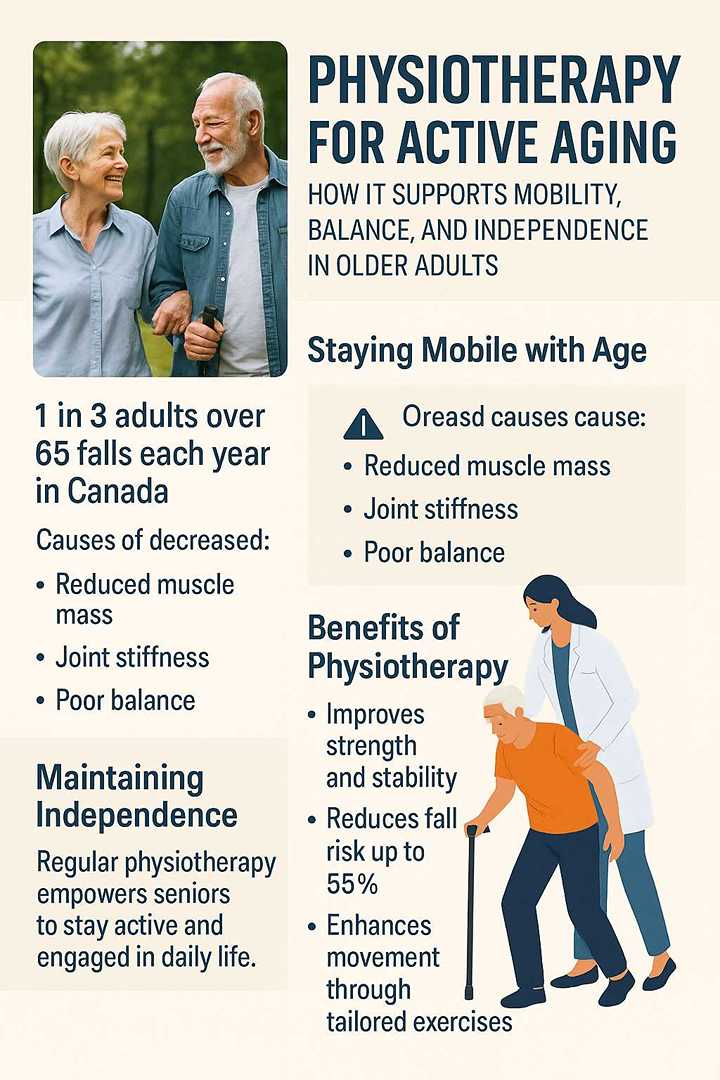
Statistics Canada projects that by 2036, nearly 30 % of British Columbians will be 65 or older — that’s over 1.6 million people. In the Township of Langley, the senior population has grown more than 40 % since 2016, with thousands moving into purpose-built retirement villages or downsizing in established areas like Murrayville and Aldergrove.
This growth brings opportunity and challenge. While many arrive fit and eager to explore Golden Ears Provincial Park or the trails at Derby Reach, natural age-related changes gradually increase vulnerability:
In BC, falls cost the healthcare system more than $500 million annually, with the Fraser Health region seeing some of the highest volumes because of its large senior base.
Modern senior-focused physiotherapy goes far beyond “gentle exercise.” Evidence-based programs combine strength training, balance retraining, flexibility work, and fall-prevention education — all tailored to individual ability and goals.
Strength and power training is particularly effective. Research from the University of British Columbia shows that twice-weekly resistance exercises (using body weight, bands, or light weights) can increase leg strength by 30–50 % in 12 weeks, directly translating to better stair climbing and faster recovery from stumbles.
Balance-specific interventions — exercises on foam pads, single-leg stands, or Tai Chi-inspired movements — improve reaction time and proprioception. BC Fall Prevention initiatives report participants cutting their fall risk by 35–55 % after completing structured programs.
Gait and mobility retraining addresses the shuffling steps many seniors develop. Cueing techniques, treadmill walking with support, and ankle flexibility drills help restore a more normal stride, reducing tripping hazards on uneven sidewalks common in older Langley neighbourhoods.
Vestibular rehabilitation targets dizziness and vertigo, prevalent in 30 % of seniors over 70. Head-movement exercises and gaze-stabilisation drills calm overactive inner-ear signals, letting people turn their head confidently while walking the dog or browsing the Langley farmers’ market.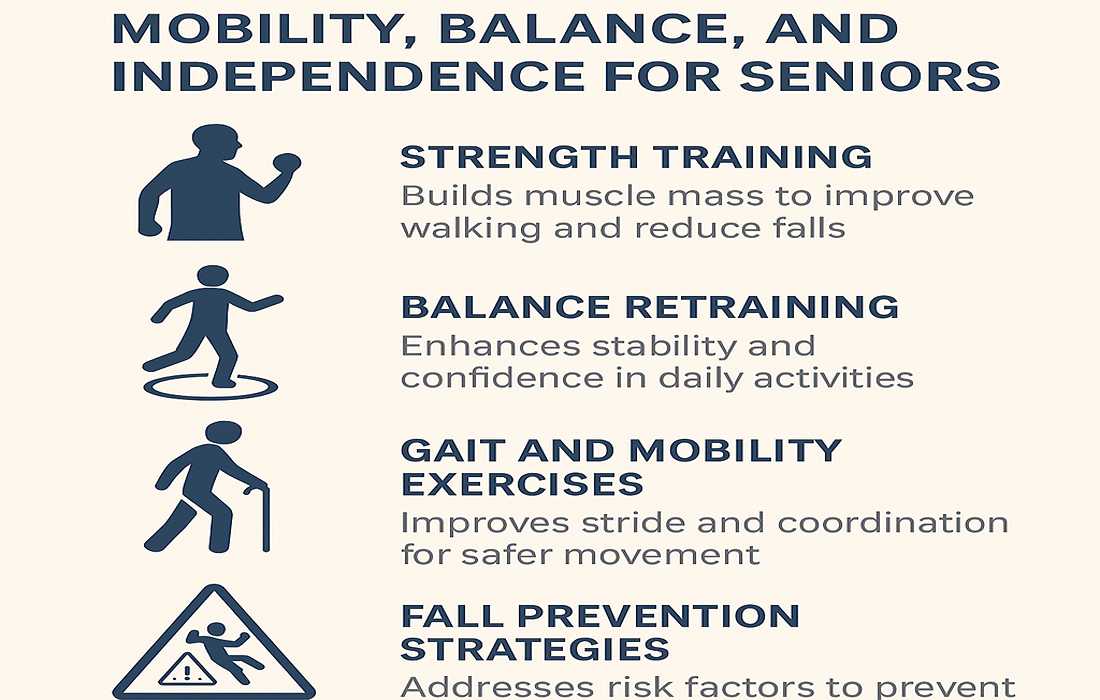
In Langley and surrounding areas, physiotherapy-led classes have become social hubs. The Timms Community Centre and Walnut Grove Community Centre offer “Steady As You Go” style programs where seniors practise real-life scenarios: stepping over curbs, walking on grass, or recovering balance after a gentle nudge. Participants routinely report walking farther, feeling steadier on ice, and gaining the confidence to travel or babysit grandchildren again.
Aquatic therapy at the W.C. Blair Recreation Centre pool provides another low-impact option. Warm water buoyancy reduces joint loading by up to 90 %, allowing pain-free strengthening that’s especially valuable for severe arthritis or post-hip-replacement patients.
Home-based programs extend reach. Many Fraser Health physiotherapists now offer virtual or hybrid sessions, teaching exercises that fit into daily routines — heel raises while brushing teeth, sit-to-stands during TV commercials, or balance practice while waiting for the kettle.
Falls remain the biggest threat. A single hip fracture often marks the beginning of functional decline: 20–30 % of seniors lose the ability to live independently afterward. Physiotherapy’s proactive approach dramatically shifts outcomes. BC data show seniors who complete fall-prevention physiotherapy are 40 % less likely to be admitted to hospital for injury over the following year.
Vision, medication side-effects, and home hazards all interact with physical capacity. Comprehensive assessments in clinics serving Langley, Aldergrove, and Fort Langley identify these risks early, recommending everything from brighter hallway lighting to vitamin D supplementation alongside targeted exercises.
The most successful seniors treat physiotherapy as maintenance, not crisis care. Regular “tune-ups” every 6–12 months catch small issues before they become big problems. Many combine clinical sessions with community offerings — Otago Exercise Programmes, Forever Active classes, or gentle yoga at the Langley Seniors Centre.
Healthcare access helps. In British Columbia, extended health plans typically cover 10–20 visits per year, while some MSP subsidies apply for low-income seniors. ICBC and veterans’ benefits often fund rehabilitation after accidents or surgeries.
Active aging isn’t about denying time — it’s about maximising quality of life at every stage. In the Fraser Valley, where mild winters and beautiful surroundings invite movement year-round, physiotherapy gives seniors the tools to keep saying yes to hikes in Campbell Valley, golf at Tall Timber, or dancing at the Legion.
For residents in Langley and surrounding communities looking for personalised, senior-focused programs grounded in the latest evidence, Inspine Therapy Langley continues to lead the way in supporting mobility and independence.
Staying active and independent as we age is one of the greatest gifts we can give ourselves and our families. In British Columbia, where natural beauty and community spirit run deep, physiotherapy makes that gift achievable for thousands of seniors every year.
Structured balance and strength programs cut fall risk by 35–55 %, with even greater reductions when combined with home safety changes.
Yes — when supervised and progressed gradually, resistance training is one of the safest and most effective ways to rebuild muscle and bone density.
Extended health plans usually cover 10–20 visits annually; low-income seniors may qualify for MSP subsidies, and ICBC/WorkSafeBC often fund injury-related care.
Many notice better balance and confidence within 4–6 weeks; significant strength gains typically appear by 12 weeks of twice-weekly sessions.
Comments (0)