The Future of Stem Cell Therapy in ALS
9 months ago 448


Amyotrophic Lateral Sclerosis also referred to as ALS or Lou Gehrig Disease is a crippling neurodegenerative disorder which gradually kills motor neurons in the brain and along the spinal cord that result in muscle debilitation, paralysis, and eventual respiratory insufficiency. Treatment is very limited in ALS patients; over the decades, all they could do was to slow down the development of the disease by several months in spite of medication.
Nonetheless, stem cell therapy is coming as a tunnel of hope, which truly promises hope to incurable patients of this disease.

ALS attacks motor nerve cells which regulate voluntary movements of the muscular movement and results in rapid degeneration of the neural pathway and atrophy of the muscles. At this moment, ALS has no cure and even approved pharmaceuticals show limited effectiveness. This is a dark truth that has compelled scientists to consider stem cell therapy as a possible game-changer among patients who are in dire need of more treatment options.
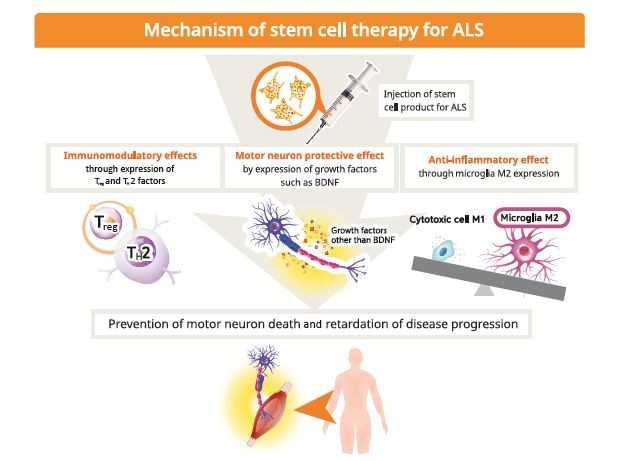
Mesenchymal stem cells have various therapeutic effects and can cover the multifaceted pathophysiology of ALS. Instead of trying to create a substitute to individual dead motor neurons (which is technically difficult) the stem cells use what researchers refer to as the neighborhood theory approach.
When stem cells are transplanted they provide a supportive and neuroprotective microenvironment around the diseased motor nerves, which slows neurodegeneration and cell death.
These cells achieve this using various mechanisms:

The mesenchymal stem cells have been tested in clinical trials related to ALS, and their results are encouraging in terms of both the safety and effectiveness. An iconic trial conducted in the JAMA Neurology provided evidence of the safety and good tolerance of intrathecal as well as intramuscular admission of the mesenchymal stem cell-derived neurotrophic factor cells (MSC-NTF cells) in individuals with ALS. There were no severe instances like tumor development.
A highly significant, phase II clinical trial demonstrated that frequent, intrathecal injection of autologous mesenchymal stem cells delayed the progression of the disease in most ALS patients who received it. More than 25% of disease progression per month was reduced in 79 percent of patients between the first and second injection. There were some patients showing real clinical improvement, whose functional scores increased after the treatment, which is very rarely shown in the manner the ALS disease is treated.
A study on 19 ALS patients followed during a 9-year period discovered a substantial reduction in the progression of the disease and an extension in the life span of multiple patients with no severe complications being reported. These findings are significant contributions to patients living with an ailment that did not allow them a chance to delay the disease.
Here are some of the latest advancements in ALS research:
Recent developments on ALS researches have gone beyond direct cell transplantation. The induced pluripotent stem cells (iPSCs) obtained using the skin samples of ALS patients are being utilized by researchers to generate personalized motor neuron models in the laboratory.
This discovery enables scientists to analyze the mechanisms behind the diseases of a single patient and provides a quick method to test specific drugs to fit a specific patient with ALS.
Researchers have also learned to produce functional mature motor neurons of stem cells within 2 weeks only, making treatment development and drug screening faster as well as providing individualized cure.
These advancements are enhancing the rate at which ALS is being studied and making it a reality that we will develop treatment options.
The use of stem cell therapy is a paradigm shift in the treatment of ALS instead of the treatment of symptoms, the treatment of the disease and the preservation of the nervous system. Although further studies are required to maximize cell types, dose regimens, and routes of delivery, recent clinical data indicate cell therapy can reduce the rate of disease progression in ALS, enhance motor activity, and increase survival.
It is also evolving fast towards bigger and well-controlled clinical trials that will conclusively determine the importance of stem cell therapy in the treatment of ALS. Stem cell therapy provides hope to patients and families who experience ALS since the disease has historically been unresponsive to conventional methods of treatment.
Comments (0)