Post-nasal drip vs asthma: Differentiating upper vs lower airway symptoms
12 months ago 962

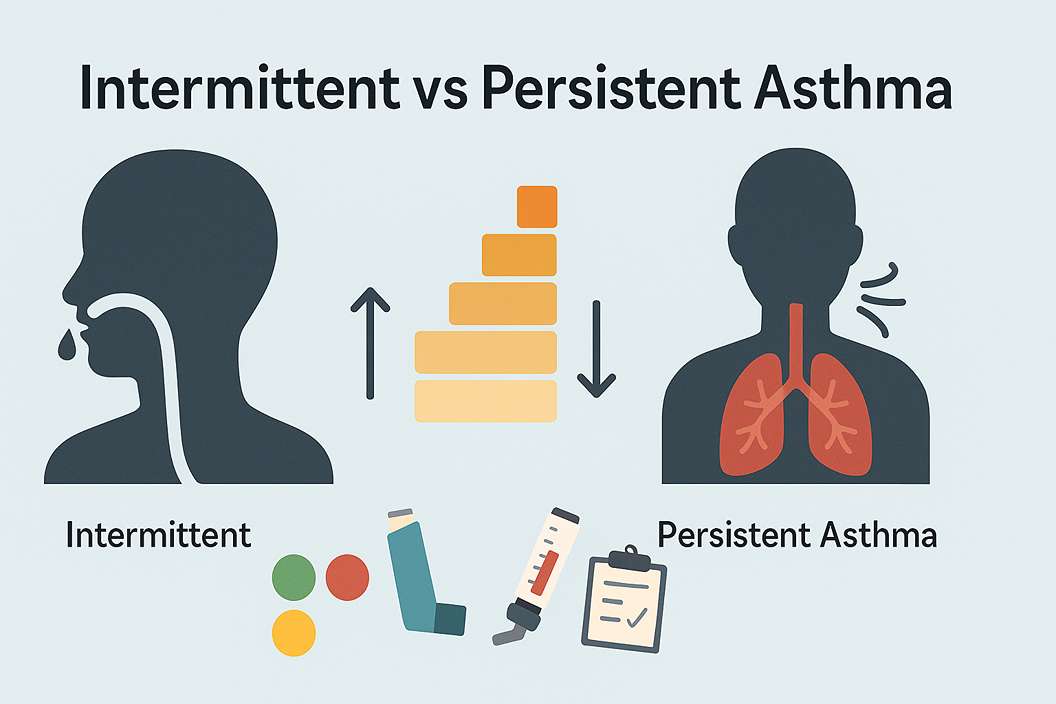
Asthma shows up differently for each person. Maybe you’re fine most days and only wheeze with a cold - or maybe cough, tightness, and night wake-ups keep nudging you. Knowing whether your (or your child’s) asthma is intermittent or persistent is the first step to smarter care. In this quick, plain-English guide, you’ll learn the symptom patterns to watch, what current guidelines recommend, and how to safely step up treatment when control slips and step down when it’s steady - so you can breathe better with fewer surprises.
These common features help clinicians place asthma on the intermittent–persistent spectrum.
| Feature | Intermittent | Mild Persistent | Moderate Persistent | Severe Persistent |
| Daytime symptoms | ≤2 days/week | >2 days/week (not daily) | Daily | Throughout the day |
| Night awakenings | Rare | 3–4×/month | >1×/week | Often |
| Reliever use (quick-relief inhaler) | ≤2 days/week | >2 days/week | Daily | Several times/day |
| Activity limits | None | Minor | some | Extreme |
| Lung function (FEV₁, if measured) | Normal between episodes | Normal | 60–80% predicted | <60% predicted |
These cutoffs come from long-standing U.S. guidance used to stage severity at diagnosis and to gauge control during follow-up. Your clinician will also consider exacerbations, which can reclassify risk even if day-to-day symptoms seem mild.
Asthma treatment works best when it matches your current control. If symptoms are frequent or you’re having flare-ups, you step up treatment. If things stay steady for a few months, you step down carefully. Before changing doses, always check the basics: inhaler technique, adherence, triggers (smoke, allergens, viral colds), and any other conditions (allergic rhinitis, reflux).
Using a quick-relief inhaler (SABA, like albuterol) by itself can calm symptoms but doesn’t treat airway inflammation. That’s why current guidance favors exposing the airways to an inhaled corticosteroid (ICS) - either daily or taken whenever you use a reliever. Even people with infrequent symptoms lower their risk of severe attacks when an ICS is in the mix.
SMART/MART means one ICS–formoterol inhaler does double duty:
What to watch: If you’re using your reliever more than 2 days/week, waking at night, or limiting activity, it’s time to step up.
Step 3: Moderate persistent pattern
If still not controlled: Re-check technique and adherence, then consider Step 4.
Step 4:
Step 5: Specialist care
Stepping up asthma therapy means increasing controller intensity when your current plan isn’t holding inflammation down. Use the last 2–4 weeks as your checkpoint.
If symptoms show up on more than two days per week, you’re reaching for your reliever more often, or you’re limiting activity (skipping workouts, slowing at work or play), that signals inadequate control.
Night awakenings from cough, wheeze, or chest tightness are an even stronger warning - occasional episodes during a cold may be fine, but recurring nights usually mean you need more anti-inflammatory medication.
Even with mild daily symptoms, one or more moderate/severe exacerbations in the past year (urgent visit, oral steroids, or hospitalization) puts you at higher future risk and typically warrants a step up.
Objective numbers matter too: low spirometry (e.g., FEV₁ <80% predicted) or peak flow <80% of personal best supports intensifying therapy.
Before changing doses, fix the foundations: confirm inhaler technique, adherence, and trigger control (smoke, allergens, viral infections), and treat co-conditions like allergic rhinitis or reflux.
If issues persist after that, try a 2–6 week step-up (e.g., start or increase ICS-containing therapy, consider SMART), monitor symptoms/reliever use/peak flow, and keep a clear action plan to reassess.
Once asthma has been well controlled for at least 2–3 months, guidelines support gradually lowering the ICS dose or simplifying the regimen while keeping a reliever strategy that still includes ICS exposure. General tips:
Most people do well with metered-dose inhalers (MDIs) + spacer or dry-powder inhalers when used correctly. Nebulizers deliver medicine as a fine mist over several minutes and can help when:
If a nebulizer is part of your plan, a quiet, portable mesh nebulizer can make on-the-go use easier.
A personal asthma action plan is a one-page guide tailored to you that explains what to do today and what to change when symptoms shift.
It uses green, yellow, and red zones to translate symptoms or peak-flow readings into steps. In the green zone, you stay on your controller medicines and use pre-exercise prevention if prescribed.
In the yellow zone - more symptoms, night waking, or peak flow 50–79% - you follow your step-up instructions for a set number of days, increase monitoring, and contact your clinic.
In the red zone - severe breathlessness or peak flow under 50% - you take reliever treatment immediately and seek urgent care if relief is incomplete. The plan lists medication names, doses, maximum daily puffs (especially for ICS–formoterol SMART regimens), spacer use, and inhaler technique tips.
It also includes your personal-best peak flow, trigger management steps (smoke, allergens, viral colds), and emergency contacts. Keep a photo on your phone and share copies with family, caregivers, school, or coaches so everyone knows the steps. Review and update the plan at every asthma visit and after any flare or medication change.
A clear, personalized plan turns guesswork into confident action and helps you act early to prevent small problems from becoming severe flares.
FAQs
Can you have “intermittent” symptoms but still be high-risk?
Yes. Even if you only have symptoms once in a while, you can still have a severe flare. That’s why current care avoids using a quick-relief inhaler (SABA) alone and makes sure you get some anti-inflammatory protection from an inhaled corticosteroid (ICS), either daily or when you use your reliever.
What is SMART/MART therapy in one sentence?
It’s using one ICS–formoterol inhaler for both daily control and for quick relief, which simplifies treatment and lowers the chance of exacerbations.
How long until I can try stepping down?
If your asthma is well controlled for 2–3 months (few symptoms, minimal reliever use, no night waking, no recent flares), you and your clinician can try a gradual dose reduction with close monitoring. Step down slowly, and be ready to step back up if control slips.
Do I still need an action plan if I’m “only intermittent”?
Absolutely. A written action plan tells you exactly what to do when symptoms start, during colds or allergy seasons, and when to seek care. Acting early - using the right inhaler, at the right dose - prevents small issues from becoming big flares.
Comments (0)