Presbyopia Treatment 101: Everything You Need to Know Before You Act
11 months ago 786

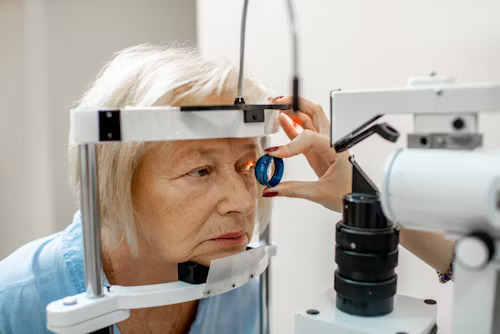
Presbyopia, the decline in near vision associated with aging, usually starts to become apparent around age 40, when the lens of the eye begins to lose its flexibility. This change in vision is a widespread, normal part of getting older.
However, it creates difficulties with things like reading, working with digital devices, and seeing details that are close up.
Faced with these challenges, a growing number of treatments promise to restore at least some of the clarity that's typically accorded to near vision. Before taking action, understanding the presbyopia treatment options is crucial. Corrective lenses, eye drops, surgical procedures, and implants are all choices to consider. Each of these paths has its own pros and cons and is a good fit for some and not for others, depending on factors like health history, lifestyle, and visual goals.
Prescription glasses are the simplest means of correcting presbyopia, and they remain the most common initial intervention. Options run the gamut from simple reading glasses (which are correcting single-vision lenses) to a variety of multifocal formats, including bifocals, trifocals, and progressive lenses, (lens additions that allow for clear vision across a range of distances but might introduce some peripheral blur). Or, if you prefer there's also contact lenses to consider.
These can be fitted in a monovision format, which means one eye sees clearly when viewing the near range (and hence has a lens that corrects only for that distance). The other eye in this scenario sees only clearly in the distance (and hence has a lens that corrects for only that range). Presbyopia also can be corrected with contact lenses to fit in a multifocal format. These lenses tend to be more comfortable and more reliable than the monovision option.
Recent advancements encompass eye drops that only need to be used once a day and that work through the creation of a pinhole effect, achieved by making the pupil smaller (that serves to enhance near vision).
These drops, in the vast majority of cases, deliver a usable effect that allows one to see clearly at near-range distances around 30 minutes after application. The effect lasts for around of 10 hours and. Reported side effects are mild and, as a rule, don't last long.
For individuals looking for lasting presbyopia treatment choices, surgery provides potent alternatives. Laser treatments like blended-vision LASIK reshape the cornea to optimize vision across focal ranges, promoting binocular visual fusion. Corneal inlays (tiny implant discs placed in the non-dominant eye) leverage the pinhole principle to aid near focus while remaining easily reversible.
More invasive options include lens replacement procedures suited for advanced presbyopia or cataracts. These surgical approaches, while effective and lasting, carry certain risks, require a good deal of recovery time, and might not be appropriate for every individual.
While presbyopia is an inevitable aspect of aging, modern vision care has a spectrum of treatments that caters to diverse needs. From classic glasses and contact lenses, through pioneering pharmacological drops, to surgical and smart wearable solutions, each path comes with its own set of benefits and considerations.
Comments (0)